Tuesday, 27 May 2014

Getting Around Barcelona


Whether you've heard of Barcelona because it is the capital of the Catalonia or due to its fantastic football team, when visiting this great city you cannot fail to be impressed.

Whenever I am asked for advice about what to do in a big city I give one answer:  If there is a hop-on-hop-off tour bus, take it.  Stay on it for the first time around and make notes of the places you want to visit.  Then second time around you can do the hop on and off bit.  By then you'll have a good idea of the layout and can go it alone.  Barcelona has plenty of these roofless double-decker buses which encompass all parts of the city that are of interest to tourists.  Bearing in mind the distances between many of the 'must see' sights the buses are well worth the expense.

Probably the most recognisable site is the unfinished church of the Sagrada Familia (Sacred Family) by Gaudi.  Building started in the 19th century and Gaudi died in 1926 (killed by a tram in Barcelona) when just one of the spires had been completed.  Now it is possible to go into the church and climb to the top to see splendid views of Barcelona.


The city has many types of architecture - Gothic, Renaissance, Neo-classical and modern.  All this as well as statues of famous people - Christopher Columbus stands on a tall column so you have to look up a long way to see him - and colourful 'shapes'.


Taken from top of the bus.
You want shopping?  Amble up the Ramblas, browse the department store called El Corte Ingles (The English Court), get lost in the side streets and find the markets.  Somewhere not to miss is in the Plaza de Espana (in Catalan Placa d'Espanya) and called Las Arenas.  A clue as to what the building originally was - it is circular.  Got it?  Another clue - bullfighting was banned in Catalonia.  That's right, it was a bullring.  To make it higher it was lifted above the street and new floor inserted.  It was then covered with a roof and a terrace.


If you need somewhere quieter then go to Montjuic which towers over the city and has gardens and museums.  As it was the centre of the 1992 Olympics there is an Olympic Museum.  And if needing to cool off there is a public swimming pool.  If you want fabulous views take the cable car back down to the World Trade Centre.

Sorry, football fans, did you think I'd forgotten you?  Yes, you can go to visit FC Barcelona's stadium.


If you want information on all that Barcelona has to offer you'll need to buy a very good guide book.  There is far too much to put into an article or a blog!

Tuesday, 6 May 2014

Back again in Florence

It was great to be back in Florence, albeit an overcrowded city.  Yes, lots of tourists and, as it was also the Easter holidays, group upon group upon group of Italian schoolchildren of varying ages.

Something which the former Mayor of Florence (now the young and handsome President of Italy) did was to ban unnecessary vehicles from the centre of this beautiful city.  Not only does it make the roads safer but has also cut down on pollution.  Everyone gains - people's health and the fabric of the historic buildings.  But when strolling do be on the lookout for bicycles!  Thousands of them.  I suspect Florentines are at lot healthier now.


If pushed for time and you don't feel the need to climb up inside the Duomo (Cathedral) don't waste time going inside.  The exterior with its white, green and pink marble facade is by far the best part and if you have strong legs you can always climb the matching bell tower.  Although at the moment the outside of the Baptistry is wrapped in plastic for cleaning purposes it is still open to the public.  The Gates of Paradise doors are replicas, the originals being in the Museo dell'Opera del Duomo along with other valuable artifacts.


Whilst I was there all of the museums at the imposing Pitti Palace were open.  The ticket office is at the far end of the building (from the Ponte Vecchio).  If you are over 65 take your passport for senior discounts and the Boboli Gardens on their own are FREE for seniors.  The palace was begun in 1440 for Luca Pitti, a rival of the Medici family for whom it has also been a home.  When Florence was the capital it was used by the Italian Royal family.


Although the Piazza della Signoria may not be a familiar name, the Uffizi is and this is where the art gallery is located, but towering over the square is the Palazzo Vecchio (Town Hall).  Even if you don't go inside to see the fabulous rooms and artwork, do pop into the courtyard to see the delightful fountain with a cherub holding a dolphin.  So sweet.


My favourite church in Florence has to be the Santa Croce with its green and white facade.  I think that is because here I can pay homage to a great musician - Rossini, who is buried at this church.  There are also the tombs of Galileo, Michelangelo, Machiavelli and a Memorial to Dante (who died in Ravenna).


You like shopping?  There are plenty of shops some of which can be expensive but there are also markets.  There is an open air one near the Church of San Lorenzo and, just a block from the Piazza della Signoria, is the straw and leather market.


Incidentally, if planning to visit the museums do remember that queues can be very long.  Advice?  Get there well before opening time.

Saturday, 26 April 2014

The Royal Alcazar in Seville

Having made my first visit to the Alhambra (in Granada) in 2013 I decided that I really must visit the Royal Alcazar in Seville.  Another palace with Arabic roots.  And some say it is more beautiful than the Alhambra.  Difficult decision.

The Alcazar is like a maze built around a central courtyard, the first room you enter being the Hall of Justice with a small marble basin and trickle jet in the centre, the water flowing out towards a pool in the courtyard.

The Moors perfected the means of keeping cool before the age of air conditioning.  Lots of fountains and running water plus shady galleries, open windows and doorways allowing breezes to waft through.

One of the more well known pools is in the Patio of the Virgins and is surrounded by gardens and wonderful Moorish arches and pillars.  Those who know the Alhambra will recognise this patio as, apparently, the in Granada was inspired by this one is Seville.

Another patio surrounded with glorious lacy looking Moorish arches is the Plaster Patio.  The Moors definitely had a way with plaster and tiles.  The Salon de los Embajadores (Ambassadors) has a dome that is decorated with gilded wood, the horse shoe arches, tiles and pretty plasterwork. 

The gardens of course are really splendid and have a fair share of pools and fountains.  In one fountain and small pool a pair of mallards were having a very splashy time.  One of my favourites is the Pool of Mercury with the winged messenger on a small plinth and surrounded by cherubs - and an occasional duck.

In front of a small temple topped with a blue and white tiles dome is the Lion's Pool.  The statue of the lion being based on the Muslim one in their decorative art.

Other gardens include a Grotto and the Flower Garden, Troy's Garden, Lady Mary of Padilla's Baths and Grotto, Pool and the Sultana's Grotto, the Poet's Garden and more that I haven't mentioned. 


Whether you visit the Royal Alcazar first or the Cathedral, you'll really enjoy the experiences.


Take a rest on this beautiful tiled seat.

Friday, 28 March 2014

Gardens of Edinburgh

This week I was delighted to learn that my article about the Gardens of Edinburgh - which include the Botanical and Princes Street gardens, as well as Calton Hill - has been published in the English magazine EVERGREEN.  This is a small, well produced quarterly magazine about all things British and very nostalgic.  I would thoroughly recommend reading it - and not just because my article is in it!

Saturday, 8 February 2014

The Alhambra - at last!

I've lost count how many times over the years I have tried to visit The Alhambra in Granada but at last, in December, I got there.
It didn't disappoint.
I hadn't realised quite how many palaces had been there.  The oldest, the Palacio del Portel is now just a tower and a pavilion with a five-arched portico.
The complex consists of the Royal Apartments, the Palace of Carlos V, the Alcazaba and the Generalife (the beautiful gardens and summer palace just north of the Alhambra).
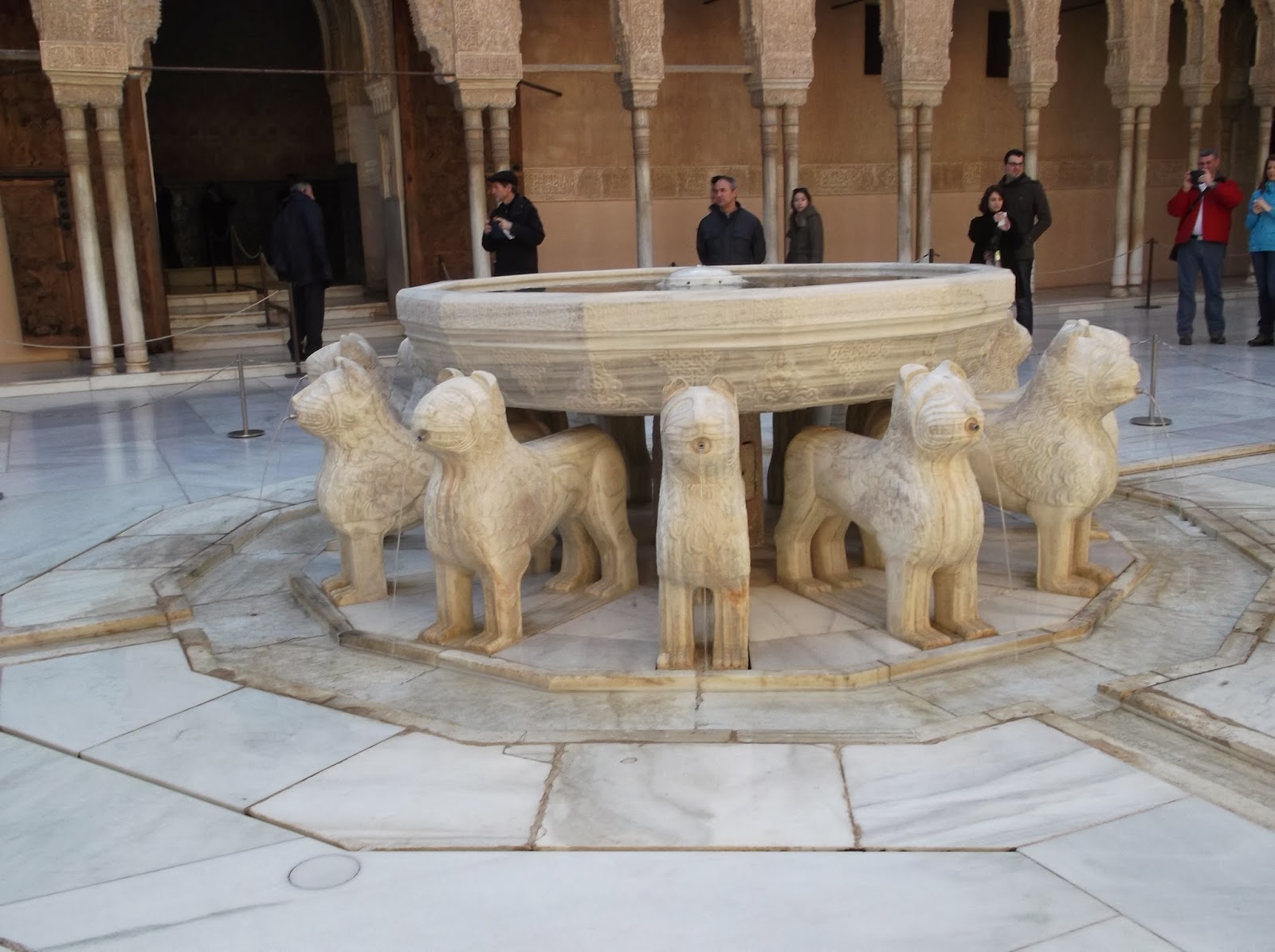
There is always some work being done to maintain this important World Heritage Site and one of the more recent areas to be cleaned is the Patio de los Leones (lions).  Not that lions were ever kept there.  It is named for the 12 marble lions that support the fountain in the centre.  The patio was built by Muhammad V and is lined with arcades and 124 marble columns.  Pretty impressive.

For me some other highlights were:

Sala de los Reyes:  A 14th century banqueting hall with a painted ceiling - on leather.

Salon de los Embajadores:  Another 14th century room.  The ceiling represents the seven heavens of the Muslin Cosmos.
The ceiling of the Salon de los Abencerrajes

Salon de los Abencerrajes, a family that rivalled Boabdil.  According to legend he had them massacred while they were at a banquet in this room.  It is said that the pattern of the stalactite ceiling was inspired by Pythagoras' theorem. I’ll take their word for it!


The Generalife is where the most famous picture is to be found - the narrow pool with fountains arching over it and a palace in the background.  Officially known as the Patio de la Acequia, it is an oriental garden and the palace is the Sala Regia.
From the terrace on one side are fantastic views across gardens towards the Alhambra.


The most 'romantic' garden is the Patio de los Cipreses, otherwise known as the Patio de la Sultana.  It is reputed to have been the secret meeting place of Zoraya (wife of Sultan Abu 1 Hasan) and her lover, the chief of the Albencerrajes.

Think Alhambra and tourists and you know it is going to be overcrowded.  If you want to see it not crowded (as I did) then I'd recommend visiting Granada in early December.  Also, of course, it isn't hot.  At the height of the summer season the heat can be unbearable.  It may not have been hot when I was there, but the sun shone!

Incidentally, did you know that the American writer Washington Irving once stayed at The Alhambra?


Saturday, 28 December 2013

Single Room Supplements


During a recent holiday where I met several other single people the subject of single room supplements came up for discussion.  When doesn't it when holidaying singles get together?  It is a decades old gripe.
In Europe where hotels have single rooms (at least half the size of a double), no bath and invariably no balcony and in the most undesirable locations it is difficult to understand why we should pay more than a couple.  These small rooms are usually 'space fillers' in the building and often found near the lifts, over the kitchen, over the dustbin area (in some countries the dustbins are emptied at night!) or over the staff entrance (some starting work at 5.00 a.m. and now the area where the staff go for a smoke).
Many years ago when I was working in tourism I dealt with hotel/tour operator contracts and discovered that the hotelier charges the tour operator half the cost of a double room for these singles.  So why the single room supplement?  We are told because they are at a premium.
FREE CHILD PLACES.  How many times do you see that in holiday brochures?  Who pays for the 'free' child's flight?  No prizes from where the tour operators get that money.
NO SINGLE ROOM SUPPLEMENT.  True - but look at the dates.  Out of season for the weeks that are difficult to sell.  Think about people who cannot take their holidays then, such as teachers.
Another catch with this phrase is that the single room supplement is included in the price.  These days some tour operators issue special Singles brochures.  Check the prices with the regular brochure and often the Singles price is higher than the normal price.
WE DON'T CHARGE SINGLE ROOM SUPPLEMENTS.  Probably means that everybody is being over-charged!
My advice?  When the hotel isn't full speak nicely with Reception and ask for a double room instead of the closet sized space.  Make sure you have your receipt showing that you've paid the single room supplement.  The majority of hotels are sympathetic and will give you a decent sized room.
AMERCAN  PLAN ROOMS.  These are hotels that don't have single rooms but charge for the room rather than per person.  You can see where the single room supplement comes in can't you?  But why, when you're one person, using one bed and one set of towels and one person's supply of water should you pay for a room that can take two or more people?   
As a single have you ever taken a cruise?  Yup, almost twice the price.  Why?  A single person only eats one person's food (and on a cruise that has to be a BIG saving). 

Sunday, 1 December 2013

Bellver Castle, Palma, Mallorca


Whether you are sailing into Palma or strolling along the promenade called Paseo Maritimo, two buildings dominate the view.  The Cathedral and Bellver Castle, which face each other across the Inner Harbour.

The circular castle with its prominent Keep stands proudly above the City, surrounded by Bellver Woods.  Like all good castles, it is on a hill so, unless you have strong legs and can climb the hill, to reach it you need either a car, a taxi or the hop-on-hop-off tour bus.

Built in the 14th c. by King James II of Mallorca Bellver is one of the most original buildings in the island's history.  It is made of sandstone and is circular with a central courtyard surrounded by 21 arches.  The floor above has 42 arches.  The four large towers face the points of the compass with the Keep (facing north) which is set off to one side.  Several Spanish monarchs have stayed at the castle, including Queen Isabella II, Alfonso XII and Alfonso XIII.  King Juan Carlos and Queen Sofia have also visited it.

During the 18th and 19th centuries the castle was a prison and, during the Spanish Civil War more than 800 republicans (supporters of the lawfully elected democratic government) were imprisoned here.  Now it houses museums including the Palma History Museum and the Despuig Collection of Classical Sculptures.

On the ground floor is the history museum and a Projection Room which is used for education purposes.  The upper story has the Chapel, the oratory of which is dedicated to St. Mark.  The presbytery floor has the original tiles in a green geometric design.

The next room is dedicated to the Spanish Justice Minister, Gaspar Melchor de Jovellanos who was imprisoned at the castle during the reign of Carlos IV (early 19th c).   This is the room that Jovellanos occupied as testified by a memorial tablet and bust.  In the Royal Chamber there are two paintings, one of Jaime I and the other of Jaime III, as well as a throne.

In the late 18th and early 19th centuries Cardinal Antoni Despuig y Dameto collection Roman sculptures and tablets.  One of the rooms on this upper floor contains them and they are gorgeous. 

The last room was the kitchen which originally had a fireplace in the centre - space that is now covered with a model of the castle and park.

I suspect that many people visit Bellver Castle for one reason only - to see the views from the 'Upper terrace' and the Keep.  As the Keep has a narrow spiral staircase of 118 steps I didn't go up but I did stroll around the terrace to admire the views.  Apart from the City itself, the hill town of Genova can be seen to the north while to the west the view is towards Cala Mayor and St. Augustin.

Amazingly, despite having once lived in Mallorca, I had never before had the opportunity to visit this fascinating castle.