Tuesday, 20 August 2013

Astoria - a Pretty Coastal Town in Oregon


The Astoria Column

Think Astoria and you usually add Waldorf in front of it – as in the Waldorf Astoria Hotel.   And this town was named for the fur trader John Jacob Astor.  At first glance from the cruise ship it looked like a collection of pretty coloured dolls houses decorating the hillside.  Interspersed with the deep green of pine trees. 

The first recorded visitors to this area were the American explorers Lewis and Clark and their party of explorers who built Fort Clatsop (named for the local Clatsop Indian Tribe) as somewhere to spend the winter of 1805/6.  The reason for their visit was because President Thomas Jefferson wanted to know if there was a river route to the Pacific Ocean.  The group left Pittsburgh on 31 August 1803 and reached the Pacific in November 1805 by following the Columbia River.   


A replica of the fort is situated just outside the town - a wooden structure with hand-hewn wooden bunks – which look most uncomfortable – tables, benches and chairs.  To add to the atmosphere park rangers are appropriately costumed and re-enact the life of the Corps of Discovery.

In 1811 John Jacob Astor, the New York financier, sent fur traders to the same area to set up a trading post.  It was they who built Fort Astoria.  Since then the town has grown around it and, literally, climbed the hills where, on top of Coxcomb Hill, is the Astoria Column.  All 38 metres of it. It was built in 1926 and is decorated with scenes showing the history of the area.

The views from the top of the hill are breathtaking.  Green hills and fields, trees of various shades from the almost black of the fir trees to the paler greens of deciduous trees.  And, winding through the landscape, the mighty Columbia River. The really strong of leg can get even better views by climbing up the 164 steps inside the column to the viewing platform at the top.

Along River Walk are shops and restaurants, Pier 11 (once a warehouse) now has shops and restaurants inside.  The 14th Street Ferry Dock has displays about the river, especially of the Columbia Bar which, long ago, was a dangerous place for shipping and, of course, there are some museums.

Don’t be surprised if Astoria looks familiar.  This is a photogenic town that has been used in many films.  ‘Kindergarten Cop’, ‘Teenage Ninja Turtles III’, ‘The Ring II’ and ‘Free Willy’ (Parts I and II) were all filmed here.

Astoria is a stop for cruise liners when relocating to or from Alaska, but if you want to spend some time here, there are some hotels.

Sunday, 21 July 2013

Apsley House, Hyde Park Corner


As you stand on the pavement at Hyde Park Corner and watch the traffic hurtle around the square it is difficult to imagine that this was once the edge of London Town.  Go and look at the address of the large house on the corner of Park Lane.  No. 1 London.  That is the address of Apsley House, the London home of the Dukes of Wellington.  The first incumbent of that title being, of course, the great Commander who defeated Napoleon at the Battle of Waterloo.


Apsley, with its Regency interior, is probably the only town house still existing intact in London.  Built in the late 18th century for the second Earl of Bathurst it was later purchased by the Marquess Wellesley.  Brother of the Duke of Wellington.  The Duke bought the house from his brother in 1817 and proceeded to have work carried out on the Robert Adam building by Benjamin Dean Wyatt. 

Wyatt added two large bays on the western side – including the picture gallery – and added a Corinthian portico to the front.  The whole structure was then encased in Bath stone. 

The staircase from the inner hall winds around the wall, above which is a glass dome.  The balustrade is a pretty white and gold iron confection while at the bottom of the staircase is an 11ft. statue by Canova.  It is of Napoleon, who ordered it to be made but once it was finished he rejected it.  Maybe he didn’t like the fact that the small statue of Victory in his right hand has her back to him.  Prophecy?


The prettiest room is the Piccadilly Drawing Room, with its yellow walls, white and gold ceiling and friezes by Robert Adam and a magnificent crystal chandelier.  At one end is an apse, in which there is a large mirror which reflects and doubles the beauty of the room.

The Waterloo Gallery is breathtaking.  There is a huge crystal chandelier depending from the central dome and the white and gold ceiling incorporates the badge and collar of the Order of the Garter.  With the gilt cornices above the doors and windows and the gold of the ceiling this room must look splendid at night.  Especially as the windows are fitted with sliding mirrors making the room resemble the Galerie de Glaces at Versailles. 

The room is now a picture gallery with many paintings by artists such as Rubens, Van Dyck, Goya and Valezquez on display.  The first Duke once had as many as 130 in here, but that was overdoing it somewhat.  The excess paintings are divided between the other rooms, making it much easier to appreciate them. 

I always think that the Plate and China Room should be left to last as it is stuffed full of fantastic items.  Sevres porcelain, silver and gold, statues, plaques, snuff boxes and the magnificent Egyptian Service by Sevres.  The centerpiece of this is the entrance to the Temple of Karnak.  Above the fireplace are ten of the Duke of Wellington’s batons – some British and others presented to him by other European countries. The whole lot is mind-blowing.

The Wellington Arch, Hyde Park Corner

Wednesday, 10 July 2013

Exeter's Woollen Trail


River Exe at Cricklepit Bridge
In the 16th and 17th centuries one of Devon’s main products was wool.  This was in the form of cloth which was finished on Exe Island in Exeter and shipped from there to France, Spain, Portugal and Holland. That was until the Napoleonic wars and the advent of woollen mills in the north of England.

Whilst in Exeter I took myself on the self-guided walk of the Woollen Trail.  Starting at the Guildhall I strolled down the High Street to find Mint Lane which leads to St. Nicholas’ Priory.  Built nearly 1,000 years ago as a Benedictine Monastery, the priory was partly destroyed during the Dissolution.  Some of this building has also been home to two of the city’s prominent wool merchants.

Turning about I returned to the High Street/Fore Street, then it was a right turn to find Tucker’s Hall.  This is where the Clothworkers Guild met to the discuss the quality of workmanship and apprenticeships.  The gates are fascinating – the tools of the trade are in the ironwork.


The Old Bridge
Back to Fore Street and the New Bridge from where you can see the remains of the Old Exe Bridge.  The first bridge built there was in 1200 and it was this bridge that packhorses and horse-drawn carts used to access the town.


Cricklepit Mill
Exe Island isn’t really an island, but a section of land that juts out into the River Exe.  Once upon a time it was an industrial area with mills, fulling stocks, cloth drying sheds and racks.  Apparently the noise was horrendous as heavy hammers pounded the newly dyed cloth.  Cricklepit Mill is located here and was one of the water mills used to supply the necessary water.


Custom House and coffee shop
The walk continues along Commercial Road to the Quays but I cut through between the buildings to find Cricklepit Bridge over the now peaceful river and spent time watching the swans.  Then I headed for the Quays, a sit down and a cup of coffee.  It was a lovely morning as I sat outside the small coffee shop beside the Custom House.


There are two other self-guided walks – the Exeter Medieval Trail and The City Wall.  Leaflets can be picked up at the Exeter Visitor Information Centre which is near the bus station on Paris Street.

Friday, 28 June 2013

Altan Ha and the River Wallace in Belize


Along with Mexico and Guatamala (its neighbours), Belize was once a part of the Mayan nation.  Many people assume that Mayan’s no longer exist.  Not true – their descendents are thriving.  Admittedly some have intermarried with other races.  In Belize as well as Maya there are the Mestizo who are a mix of Maya and Spanish. The drive to the ancient Maya city of Altan Ha from Belize City was rather bumpy but we did arrive safely.  The complex is large with two plazas containing thirteen structures, some of which were temples.  Not all of the ruins have yet been excavated so it is possible to look ‘around the back’ to see grass and brush covered buildings.

It was here that Professor David Pendergast of the Royal Ontario Museum discovered the jade head of the sun god Kinich Ahau.  Excavations began in 1965 when it was realised that Altan Ha had been a trading centre.  As well as the jade head, at least 250 buildings were found in this area.  The head was one of several jade treasures discovered in the Temple of the Green Tomb.  Other pieces included beads, earrings and rings.  The head itself is the largest piece of jade carving found in any of these Maya countries.  Weighing in at four kilos it is nearly 15 centimetres tall.  It is now at the Department of Archaeology in Belmopan. 

Having strolled around the ruins and renovated structures in the two plazas it was time to clamber up the modern wooden staircase to reach the top of one of the pyramids the better to survey the scene. 

From Altan Ha we drove south on the Northern Highway to visit the village of Barrel Broom where we had lunch then boarded the boat for a cruise down the Wallace River.  Or perhaps I should call it the Belize River. 

There are differences of opinion as to how Belize got its name in 1973 after being British Honduras.  One theory is that it is corruption of Wallis – pronounced Wahleez – after the pirate, Peter Wallace. 

So to the cruise down the Wallace/Belize River which was fascinating and exciting with loads of crocodiles enjoying the sun.  We could just about see the Howler monkeys up in the trees as were some of the iguanas.  These are Green Iguanas except that, because it was the mating season, the males were bright orange – to attract the females, of course.   There were also plenty of small colourful birds which didn’t stay still for long enough to identify.  Once out of the river and into the bay the engine was shut down and we indulged in a little Manatee watching.  All you actually see is the mouth popping up out of the water as they breathe, then it was back to our cruise ship. 


By the way, ladies, if offered a drink of Coconut Wine be very, very careful.  Its nickname is ‘Panty Ripper’.

Monday, 10 June 2013

The Lasithi Plateau


The  most famous country visit in this eastern part of Crete is the Lassithi Plateau - actually a flat floored valley.

Our first view of the plateau was from the pass at Seli Ambelou with the ruined stone windmills above the road.  Down on the plain are several small communities dotted about the verdant patchwork of farmland, apple and cherry orchards and vineyards.  Here they also grow vegetables and grain and the small dots of white in the meadows turned out to be sheep.

The road leads down into the valley and round to Psyhro on the southern edge.  Here we parked so that those with strong legs could follow the footpath up to the Dictean Cave where Zeus was fabled to have been born.  Incidentally, for those who cannot do the climb but are really anxious to see the cave there are some donkeys to take you up - at a price, of course.

The rest of us either looked around the souvenir shops and took photos of the valley or sat at one of the cafes and drank freshly squeezed orange juice.
The remains of the old stone windmills


Our late lunch break was at the restaurant at the Seli Ambelou Pass.  It was lovely to sit outside looking over the valley while we ate and discussed the tour.  I was with some people from another hotel (different resort) and realized that I would have had a much better holiday if I had stayed there.

Something the Lasithi Plateau was famous for was its windmills.  A few have been preserved but most are derelict and others merely decorative.

Between the beautiful countryside and the heart-stopping mountain passes this was a fabulous day out - and we were lucky enough to have our favourite guide.


One of many vineyards in the valley

The Cretan Countryside

The distant mountains almost seem to be blue.


 Having chosen the wrong resort in which to spend my holiday, it was a great relief to take excursions into the beautiful countryside with its varied scenery.  The coastline has, of course, its beaches, coves and rocks and, away from the tourist centres, there are delightful villages and small towns to explore. Inland are the mountains (still a little snow on the tops in May!), tree clad hills and valleys.  Some of the towns and villages still have cobbled streets but all have their churches and town square with bars which is where, on Sundays, the men gossip while the women go to church to pray for them.  At least, that is what our guide told us!

To reach the true Cretan  countryside you have to cross the mountains from where the views are fantastic.  Behind us was the shoreline stretching from Hersonissos to Malia with the sun sparkling off the blue water.  Over the top of the pass the scenery dramatically changes.  Olive groves and vineyards, farms and market gardens.  The mountain slopes are decorated with scrub and pine trees and the vistas seem to stretch into infinity.

We stopped off to visit a potter who, in the space of about two minutes created an enormous jug.  Then took a look at his outdoor kiln and wandered in to inspect another studio where he makes smaller items and, of course, roamed the souvenir shop.  Yes, there were some beautiful things that almost tempted me but I long ago decided that I don't need any more  souvenirs.

Following that break we visited a winery - as I've visited more of these than I care to remember, I'm afraid the details of this one escape me.  I do remember using the time viewing a video about the company and the processes as an ideal time for a cat nap.  Fortunately I was awake for the  comedic part of the film - about Raki.  We were told that when offered a glass you should never refuse it.  I guess the camerman hadn't as the pictures, instead of being upright they were lopsided.  What I once heard referred to as 'skew-whiff'.  Definitely skewed - slewed.

Of course there was some wine tasting. What was the wine like?  Not being a wine buff I can only say that they weren't really to my liking.


All in all it was a very pleasant afternoon out made all the better by having a super guide - with a sense of humour.  He brought the story of Zeus into the 21st century by telling us that Zeus left Hera (his wife) and took off in his 'cloud Ferrari', then met Europa. As he really fancied her he called Hera on his mobile to say he'd be away for a while.

Foller that!


Thursday, 6 June 2013

The Minoan Palace of Knossos


I first visited Crete many years ago but didn't have the opportunity to go to Knossos.

As that holiday was made during the autumn I had another good reason for this second springtime visit.  To see the wonderful flowers - oleander, bougainvillea, roses, geraniums and wild flowers.  Absolutely beautiful.

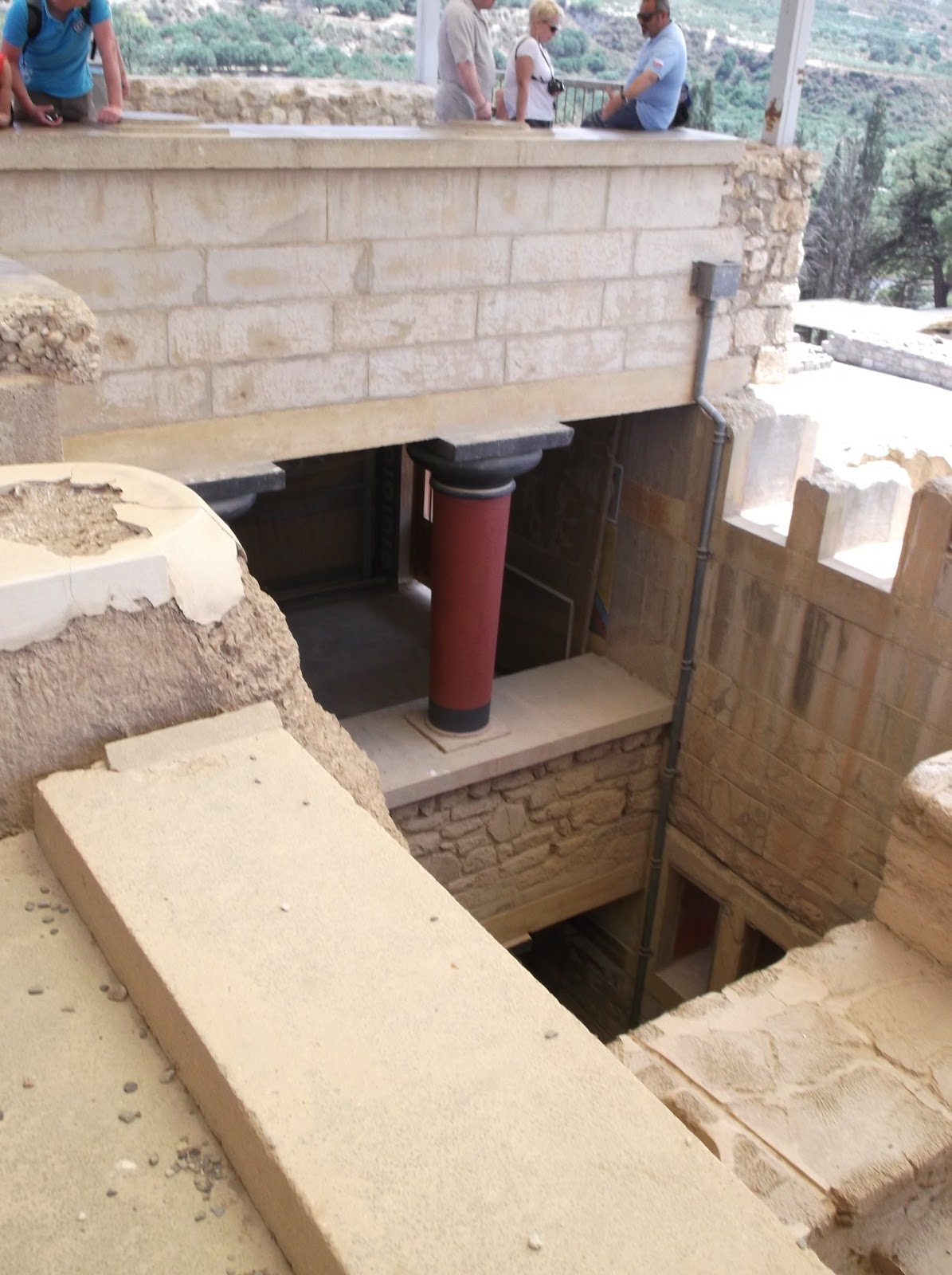
The great Palace of Knossos was first excavated in the 19th century but the more extensive excavations done were in the early 20th century.  It was then that Sir Arthur Evans uncovered almost the whole of the palace.

The earliest traces are Neolithic and several palaces (including a Roman one, of course - they got everywhere) have occupied the site.  Some of them were destroyed by earthquakes, at least one by fire and others possibly by warfare.

Remembering that in the 19th and early 20th centuries the mind set so far as excavations was concerned included reconstructions and Sir Arthur fulfilled that desire.  He re-created a multi-storey building covering about 20,000 square metres.  This included some of the  murals that had adorned the original palace.  Those are in the Heraklion Archaeological Museum with copies to be seen at the site.

Following a twenty minute lecture by an official guide - standing in the hot sun (all of us over 60 years old and some disabled) we then commenced our tour of the site. Perhaps they should create an auditorium so we can sit down to be bored out of our skulls.  At our age we already knew the history.  In any case she had already told it to us in the coach.  I began to think of her as a wind up doll with a repeater.

From this large Central Court which had ironically, been used for public meetings we went to the West Court - which had been the official entrance.  Rather like the front entrance to Buckingham Palace that is used for posh events, otherwise the side entrance is used.

The West Wing (oops, shades of the White House in Washington) had the official rooms, both admin and religious.  The latter had a Tripartite Shrine, Sacred Repositories and the Pillar Crypts - sorry, read that off the leaflet.

My favourite is the Throne Room with a basin and alabaster throne (I reckon that's a copy).  Among other things pointed out is an original staircase - you look down to that.  Just imagine the number of people that have stepped on that over the 1,000 or so years.  Could be a lot longer but how do we know whether we are looking at the original stairs or not?

Between actual history and legends it is easy to become confused as to what is real and what is myth, which is why it is a good idea to read it all up before you go.

I lost count how long it took to be taken around the site but probably about an hour.  My suggestion would be to read it up first, then do-it-yourself.  That way you can avoid the coach loads and official guides who seem to take up all the room.  If you are there on your own and and want to listen to any of the guides you can always temporarily tack yourself onto a group.


Not sure whether these pots are original!


At the end of the tour of lectures we were surprised there wasn't a written test!