Thursday, 6 June 2013

The Minoan Palace of Knossos


I first visited Crete many years ago but didn't have the opportunity to go to Knossos.

As that holiday was made during the autumn I had another good reason for this second springtime visit.  To see the wonderful flowers - oleander, bougainvillea, roses, geraniums and wild flowers.  Absolutely beautiful.

The great Palace of Knossos was first excavated in the 19th century but the more extensive excavations done were in the early 20th century.  It was then that Sir Arthur Evans uncovered almost the whole of the palace.

The earliest traces are Neolithic and several palaces (including a Roman one, of course - they got everywhere) have occupied the site.  Some of them were destroyed by earthquakes, at least one by fire and others possibly by warfare.

Remembering that in the 19th and early 20th centuries the mind set so far as excavations was concerned included reconstructions and Sir Arthur fulfilled that desire.  He re-created a multi-storey building covering about 20,000 square metres.  This included some of the  murals that had adorned the original palace.  Those are in the Heraklion Archaeological Museum with copies to be seen at the site.

Following a twenty minute lecture by an official guide - standing in the hot sun (all of us over 60 years old and some disabled) we then commenced our tour of the site. Perhaps they should create an auditorium so we can sit down to be bored out of our skulls.  At our age we already knew the history.  In any case she had already told it to us in the coach.  I began to think of her as a wind up doll with a repeater.

From this large Central Court which had ironically, been used for public meetings we went to the West Court - which had been the official entrance.  Rather like the front entrance to Buckingham Palace that is used for posh events, otherwise the side entrance is used.

The West Wing (oops, shades of the White House in Washington) had the official rooms, both admin and religious.  The latter had a Tripartite Shrine, Sacred Repositories and the Pillar Crypts - sorry, read that off the leaflet.

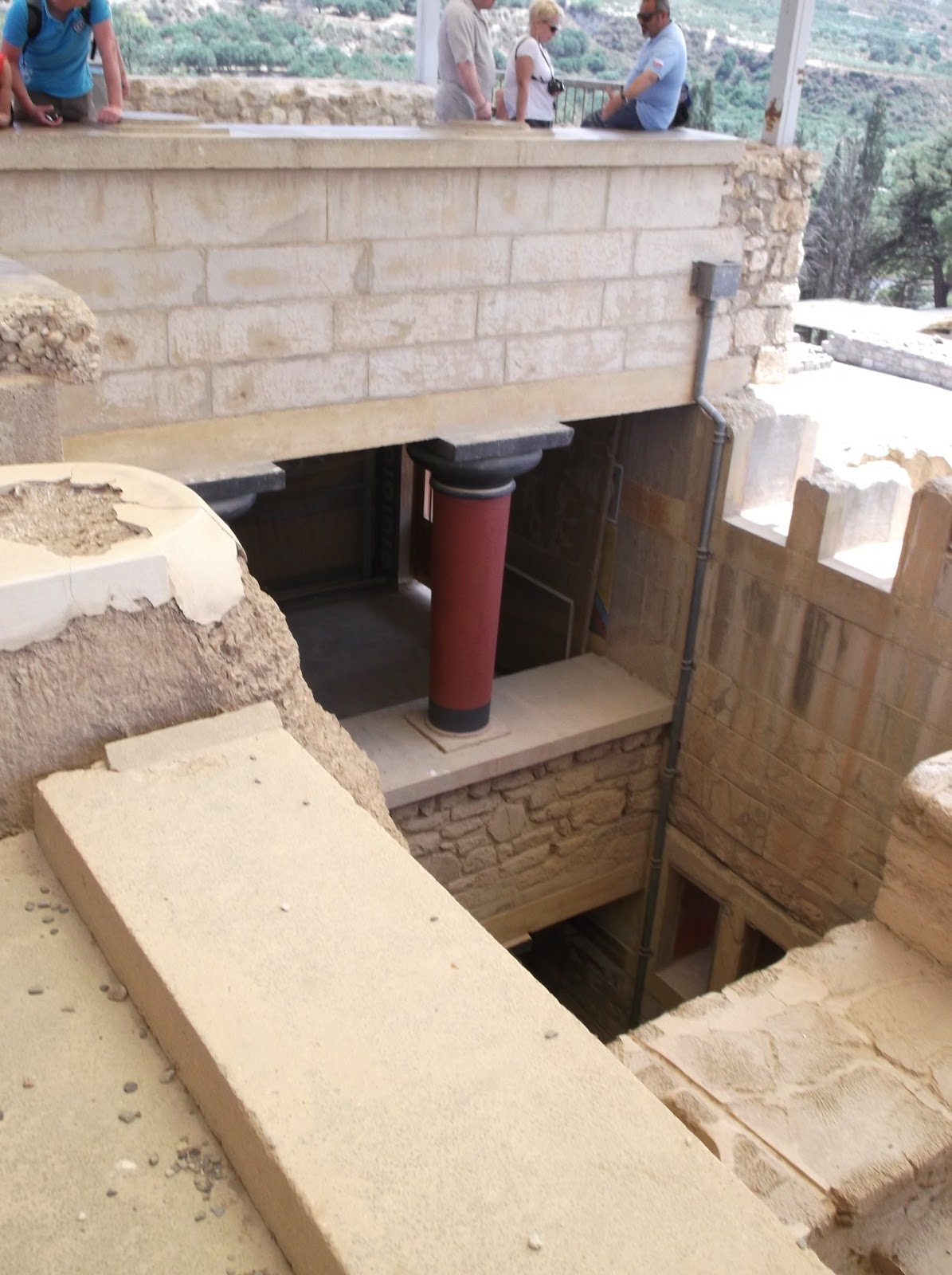
My favourite is the Throne Room with a basin and alabaster throne (I reckon that's a copy).  Among other things pointed out is an original staircase - you look down to that.  Just imagine the number of people that have stepped on that over the 1,000 or so years.  Could be a lot longer but how do we know whether we are looking at the original stairs or not?

Between actual history and legends it is easy to become confused as to what is real and what is myth, which is why it is a good idea to read it all up before you go.

I lost count how long it took to be taken around the site but probably about an hour.  My suggestion would be to read it up first, then do-it-yourself.  That way you can avoid the coach loads and official guides who seem to take up all the room.  If you are there on your own and and want to listen to any of the guides you can always temporarily tack yourself onto a group.


Not sure whether these pots are original!


At the end of the tour of lectures we were surprised there wasn't a written test!


Saturday, 25 May 2013

ALL-INCLUSIVE/RESORT HOTELS


If you are looking for a 'quiet' holiday then these hotels are best avoided.  Earlier this year I went to Cuba for a week - the hotel was 'all inclusive'.  This is fine if you like cheap booze, mediocre food and lots of noise around the pool, including SHOWTIME in the evening usually with ear-drum splitting music.

I have just returned from a similar holiday in Crete.  This turned out to be a 'Resort' with two hotels.  There are several pools (including an Olympic sized one), free cheap booze, very mediocre food (my lunch often consisted of salad and chips).  I went in May because I didn't want to be surrounded by children.  During the first week there were a few groups of children, most of whom were left to run wild in the hotel until their parents wanted to go to bed - 11.00 p.m.-ish.  The second week we were inundated with babies and toddlers - again kept up until parents wanted to go to bed.  And, of course, all of these parents wondered why their children were whiny and miserable and full of tantrums!

As I was with a well known tour company for the over 60s, you can imagine how we all enjoyed our stay.

My feeling is that these all-inclusive hotels/resorts attract people who like to get thoroughly pissed on cheap booze and like a lot of noise - in fact make a lot of it themselves.

Anyone for Butlins?

Wednesday, 17 April 2013

Russian Dancing in Alaska


 “Yip! Yip!”  some of the energetic dancers call out as they swirl around the stage.
The rhythm of the music is infectious, the brilliant scarlet, emerald and azure of the skirts as they flare out is mesmerising.  Then the ladies stop to sway in time with the music and encourage the young men in their black trousers, white tunics and black Cossack hats as they perform, crouching down and bouncing on their toes, kicking out, then rising to leap high in the air touching their toes with their hands in typical Russian dance fashion.

Except that they aren’t young men, but women.  Very fit ones.

These are the New Archangel Dancers of Sitka in Alaska.  As Sitka was the capital of Russian America, it isn’t surprising to see Russian dancing here. 

In 1969 a group of young women got together to learn the dances of the town’s heritage.  They did it for fun and to preserve Sitka’s history, even though none of them are of Russian descent.

During a break in the dancing one of the ladies tells the story of their formation including the fact that the men had been invited to join them.  The men refused feeling that it was beneath the dignity of strong fishermen and hunters to do something so ‘sissy’.

The women went ahead without them and have been having fun ever since.  Now, during the bitterly cold winters the Dancers often leave Alaska to tour, not only in the United States, but around the world.

And, yes, the men have now changed their minds but the women prefer to play all of the roles themselves.

The dances are authentic Russian folk dances including the energetic ones that most people recognise.  Then there are the romantic boy and girl flirtatious ones, sailor tap, dances with handkerchief or ribbons, the Cossack Horsemen (this one is a great favourite with the children in the audience) and the elegant Beryozka Gliding Dance.  In this dance the ladies wear long dresses and move smoothly around the floor giving the impression that they are on wheels.

The nearest I got to a bear in Alaska!
As well as touring in the winter, the Dancers perform throughout the summer mostly for tourists from the cruise ships that call at Sitka.  They also showcase Alaska’s Russian heritage with performances on Alaska Day and at special events such as conventions, banquets, fund raisers and other celebrations.

Tuesday, 9 April 2013

Havana Cuba

As we drove towards Havana I was amused to see that buses driving away from the city had destination boards saying 'Havana Cuba'. Presumably the people catching them know where they are going.

I fell in love with Cuba's capital from the Old Town to the more modern sector. The Old Town is a mix of cleaned up buildings and some that look as if a gust of wind will blow them down. (What a good job hurricanes usually arrive from the east and south and lose power once they make landfall - Havana is on the Northwest coast). The atmosphere is great probably for the history that has permeated those buildings and the happy and friendly Cubans who people it.


Cigar Sellers in national costume

As the Old Town is now a World Heritage Site monies have become available to help restore some of the lovely old buildings. One of those buildings having work done to it while we were there was the imposing Capitol which is neo-classical and has a flight of steps up to the front door. I wandered around the area to get a feel for the City and in a nearby square found men debating - not sure whether it was football, baseball but I doubt it was politics. There were plenty of people about - tourists and friendly Cubans - but it is a bit of a gamble crossing the roads!

We were then driven to Revolution Square with its 109m. high obelisk. This is where Fidel Castro made his speeches to thousands. We were told that people filled the huge square and surrounding streets just to listen to their leader giving speeches that ranged from two to nine hours. Two of the buildings in the square have 'sculptures' by Enrique Avila of Che Guevara and Commander Camilo - the other two of the triumvirate (Fidel being the third). There isn't one of Fidel as the policy is no statues or images until after the Leader has died.

Something which catches the eye traffic-wise are the old cars. Colourful vintage American cars such as Chevrolets (Chevies) and Packards. Mostly they are now taxis and the drivers expect you to pay them if you want to take a photograph. The reason they are still around is that when the USSR broke up Cuba lost its 'mother-lode' and they could no longer get Russian cars. Many people had either put their old American cars into garages or sheds (or even just left them to rot) and found that in order to have a working car they would have to renovate the old ones. Now some of them are, on the outside, American cars but under the bonnets/hoods they have Russian engines.

Following a super lunch at the Pina de Plata (Silver Pineapple) restaurant we strolled through the old town before having some free time. Me? I chose to sit in Cathedral Square sipping a Cuba Libre, listening to Cuban music and thinking about some of the famous people who have either lived or visited Havana.

Graham Greene stayed there and got his idea for 'Our Man in Havana', Alec Guinness and Noel Coward were there for the making of the film, Zelda and F. Scott Fitzgerald had a short holiday there and, of course, Ernest Hemingway lived there at the Hotel Ambos Mundo. (I have written about his stay which is on my other blog: www.barbarabothwell.blogspot.com).

Thursday, 3 January 2013

Salobrena - A Holiday with Problems


The pool and Salobrena
I'm sure everyone has at least once in their life planned a holiday only to have it go horribly wrong. Travel journalists aren't exempt!

In 2012 my trip to Bath was soggy, in Edinburgh I was plagued with chronic back ache (fault of prescription pills - now back on over-the-counter ones) and Spain in December joined the club.

Salobrena is not the best location for someone with a back problem - I should have done my research before booking. But that wasn't the main problem. Without one of the other problems that cropped up I could probably have managed okay.

As the flight out was horrendously early it meant an overnight at an airport hotel. I should have known when the train pulled out of the station and I realized that I had left my overnight bag at home that this was a fated holiday. On arrival at London Gatwick it was a trip to Boots for toiletries. No cosmetics in that branch. I had to wait until the next morning after going through Security before I could buy the face paint and make myself look human.

Knowing that at that time of the year the hotel would be almost empty I hoped they had good PR and would allocate me a decent room. Not one of those awful European single rooms - the width of 2 beds, a bathroom in which you can barely move, no view and located in noisy and/or smelly area. As this was a Best Western hotel I handed over my card with my passport only to have it returned to me with a grumpy, "Bring it back later I don't have time now." There were only two couples to check in after me! I was handed my card key and told the room number - 102. Yup. Had to be a single didn't it? Over the front door with a view of a flat roof and the side of another building. No way!

I hot footed it back to reception where the last couple were checking in and as soon as they cleared the desk I put my Best Western card and press card on the counter and told the receptionist (possibly manager?) in no uncertain terms that I wanted a better room. That as a regular user of Best Western hotels I expected some consideration. She, two other receptionists and the Saga rep were gob-smacked. Well, I had said it all in Spanish! I got my other room - on the third floor, a double with balcony overlooking the pool and a splendid view. As they say, it pays to complain!

The excuse? There was a problem as it was a late booking. Eh? I had paid in full three months earlier - not exactly a late booking.

One of the things I enjoy about holidaying by myself is that I can do and see what I want without having to consider anyone else. I hate sightseeing or shopping with someone tagging along as I cannot then concentrate. That being the case I try to avoid those nice people who think I want to spend time with them. Mind you, some of them are just plain nosy! On the coach from the airport I had spotted some whom I needed to avoid but, would you believe it, I got caught. Most unexpectedly.

The first evening before dinner I went to the bar for a drink and ended up sitting with a married couple. The next morning at the information meeting the wife came into the room and sat beside me. Okay so far. After the meeting we and the rep. went on the hotel bus into Salobrena for a familiarisation tour. In the town we left the bus and followed along like good children taking in the information being imparted about local buses, locations of various places of interest etc. Then the rep left us to do whatever we wanted to do. A voice beside me said, "My husband hasn't come because he said I could stay with you so that I don't get lost."
What can you say? He didn't come on either of the included trips, not even to Granada, but the pair did use the hotel bus to go into Salobrena. I didn't get to go there again as every time I thought I might be able to jump on the bus, his wife was sitting in reception - probably waiting to see if I would go. I did fool them once. After they left on the hotel bus I got onto the tour bus to Almunecar and found that it is a far better location for someone who has problems coping with hills. There is a lovely long flat promenade with plenty of benches on which to sit and enjoy the views - or read, of course - and I discovered a delightful small park.


One of the roads in Frigiliana

Have you heard of Frigiliana? This is a pretty village that we visited. It is filled with white-washed houses that are decorated with wrought-iron balconies - all very Andalucian. And it is hilly. Some people in our group took the 'high' road while the rest of us (including my attachment) continued strolling along the lower road as far as the church square. I thoroughly enjoyed the stroll, stopping to look in shop windows and, on the way back, popping into some of the shops for a browse.

I may not have been able to do exactly what I wanted to in Granada but I did persuade my shadow to come into a restaurant and share a fabulous dish of paella.


I'm off to Croatia in just over a week. Keep your fingers crossed that this time I am hanger-on free! After all, I will be there for two weeks.

Tuesday, 4 December 2012

The House of Mateus in Portugal


People with long memories will recall a flat bottle of wine called Mateus Rose.  The label showed an ornate manor house.  Although The Casa de Mateus exists and produces wine, it never produced Mateus Rose - just provided the illustration for the label.

During my visit to the Valleys of the Douro I visited this fantastic house and its beautiful gardens.  The house was built in the early 18th century and is a National Monument.  It is of the Italian Baroque style in cream with beige dressed stone trim, red tiled roofs and ‘oriental’ style pinnacles.

The main entrance is on the first floor (second to my American readers) and is reached by staircases from the central courtyard.

Our group was divided into two for the house tour.  I don’t know what the other guide was like but the young lady who escorted us was not only informative but also very amusing - and enjoyed sending up the Establishment.

I’m not going to be boring by describing all of the rooms - you need to go there to see them.  There are some pretty stupendous things to see such as the octagonal wooden ceiling in the library with its carved central panel.  Wood is used extensively throughout the house, especially chestnut, on ceilings, for doors and door decoration.

The rooms are, of course, filled with antiques from various countries and include some ornate cupboards, ceramics worth a fortune, glassware and silverware.  Most of the paintings are of the family.

I think the items that left everyone breathless are some fabulous 18th century religious satin and taffeta garments which are heavily embroidered and, apparently, were only used once.  The thought of the number of hours women spent working on them is mind blowing.

Despite the number of people milling about in the gardens, because they are divided into sections it is possible to find quiet corners.  Near the house is the formal garden with paths between the trees radiating in all directions from a central pond.  Further away is the 20th century Parterre which, because it is on a lower level, is beautiful when viewed from the terrace.

The most well known part of the garden is the reflecting lake at the front.  As well as reflecting the facade of the house it also reflects the nearby trees.  In the lake is a sleeping figure.  It is a sculpture by Joao Cutileiro and has been in the lake since 1981.

The grape treader is on lunch break.
The Casa de Mateus does produce its own wine.  As we were there during harvest it was interesting to go into the Adega to see the vats of grapes.  We were told that the grapes are still trodden by human foot.  By one man - who was on his lunch break.

It was a lovely two to three hours and I could have happily spent the rest of the day enjoying those gardens. 

This was another of the days out during the Saga River Douro holiday.


Saga Holidays

Wednesday, 28 November 2012

A Rail Trip through the High Douro Valley


The River Douro from the train
Even if you aren’t an avid train buff, this journey is a MUST as it is one of the most scenic in Europe.

We caught the train in Ruega and travelled alongside the River Douro to Pocinho.  For most of the journey we were higher than the river so the views were fantastic.  For the first part of the journey the river was on the right and on the left it was rocks, trees and bushes but eventually the scenery appeared on that side.  Vineyards, valleys, lakes and rivers.

Between the steep hills of vineyards there are tributaries of the Douro looking like sparkling ribbons throwing back reflections of the trees and sky.  Dotted here and there are mansion houses guarded by yew trees.  Now and again can be seen a small holding with orchards of olive, walnut and almond trees.  I even spotted an ‘orchard’ of prickly pear cacti.
One of the beautifully decorated stations

Further along the route the train crosses the Douro so passengers on the lefthand side of the train can watch the green waters of the river gliding past.  Along the way the train made a few stops which wasn’t a hardship as some of the stations are beautifully decorated with blue and white tiles.

The coach met us at Pocinho to take us to Meda which is the eastern limits of the port wine region.

The Pillory in front of the castle at Penedono
Following lunch and some free time we were then taken to Penedono.  This is an ancient village perched on a rock crest 974m above sea level.  In the square was a display of instruments of torture - anyone for the rack?  Across the road is a crenellated medieval castle. In front of the castle is a tall and ornate stone pillar.  Locally it is called a ‘pillory’ and has been there since the 16th century.

This was a great day out but for those requiring a steam train, you have to go on a Saturday.

This was a part of the River Douro trip with Saga.