Saturday, 26 April 2014

The Royal Alcazar in Seville

Having made my first visit to the Alhambra (in Granada) in 2013 I decided that I really must visit the Royal Alcazar in Seville.  Another palace with Arabic roots.  And some say it is more beautiful than the Alhambra.  Difficult decision.

The Alcazar is like a maze built around a central courtyard, the first room you enter being the Hall of Justice with a small marble basin and trickle jet in the centre, the water flowing out towards a pool in the courtyard.

The Moors perfected the means of keeping cool before the age of air conditioning.  Lots of fountains and running water plus shady galleries, open windows and doorways allowing breezes to waft through.

One of the more well known pools is in the Patio of the Virgins and is surrounded by gardens and wonderful Moorish arches and pillars.  Those who know the Alhambra will recognise this patio as, apparently, the in Granada was inspired by this one is Seville.

Another patio surrounded with glorious lacy looking Moorish arches is the Plaster Patio.  The Moors definitely had a way with plaster and tiles.  The Salon de los Embajadores (Ambassadors) has a dome that is decorated with gilded wood, the horse shoe arches, tiles and pretty plasterwork. 

The gardens of course are really splendid and have a fair share of pools and fountains.  In one fountain and small pool a pair of mallards were having a very splashy time.  One of my favourites is the Pool of Mercury with the winged messenger on a small plinth and surrounded by cherubs - and an occasional duck.

In front of a small temple topped with a blue and white tiles dome is the Lion's Pool.  The statue of the lion being based on the Muslim one in their decorative art.

Other gardens include a Grotto and the Flower Garden, Troy's Garden, Lady Mary of Padilla's Baths and Grotto, Pool and the Sultana's Grotto, the Poet's Garden and more that I haven't mentioned. 


Whether you visit the Royal Alcazar first or the Cathedral, you'll really enjoy the experiences.


Take a rest on this beautiful tiled seat.

Friday, 28 March 2014

Gardens of Edinburgh

This week I was delighted to learn that my article about the Gardens of Edinburgh - which include the Botanical and Princes Street gardens, as well as Calton Hill - has been published in the English magazine EVERGREEN.  This is a small, well produced quarterly magazine about all things British and very nostalgic.  I would thoroughly recommend reading it - and not just because my article is in it!

Saturday, 8 February 2014

The Alhambra - at last!

I've lost count how many times over the years I have tried to visit The Alhambra in Granada but at last, in December, I got there.
It didn't disappoint.
I hadn't realised quite how many palaces had been there.  The oldest, the Palacio del Portel is now just a tower and a pavilion with a five-arched portico.
The complex consists of the Royal Apartments, the Palace of Carlos V, the Alcazaba and the Generalife (the beautiful gardens and summer palace just north of the Alhambra).
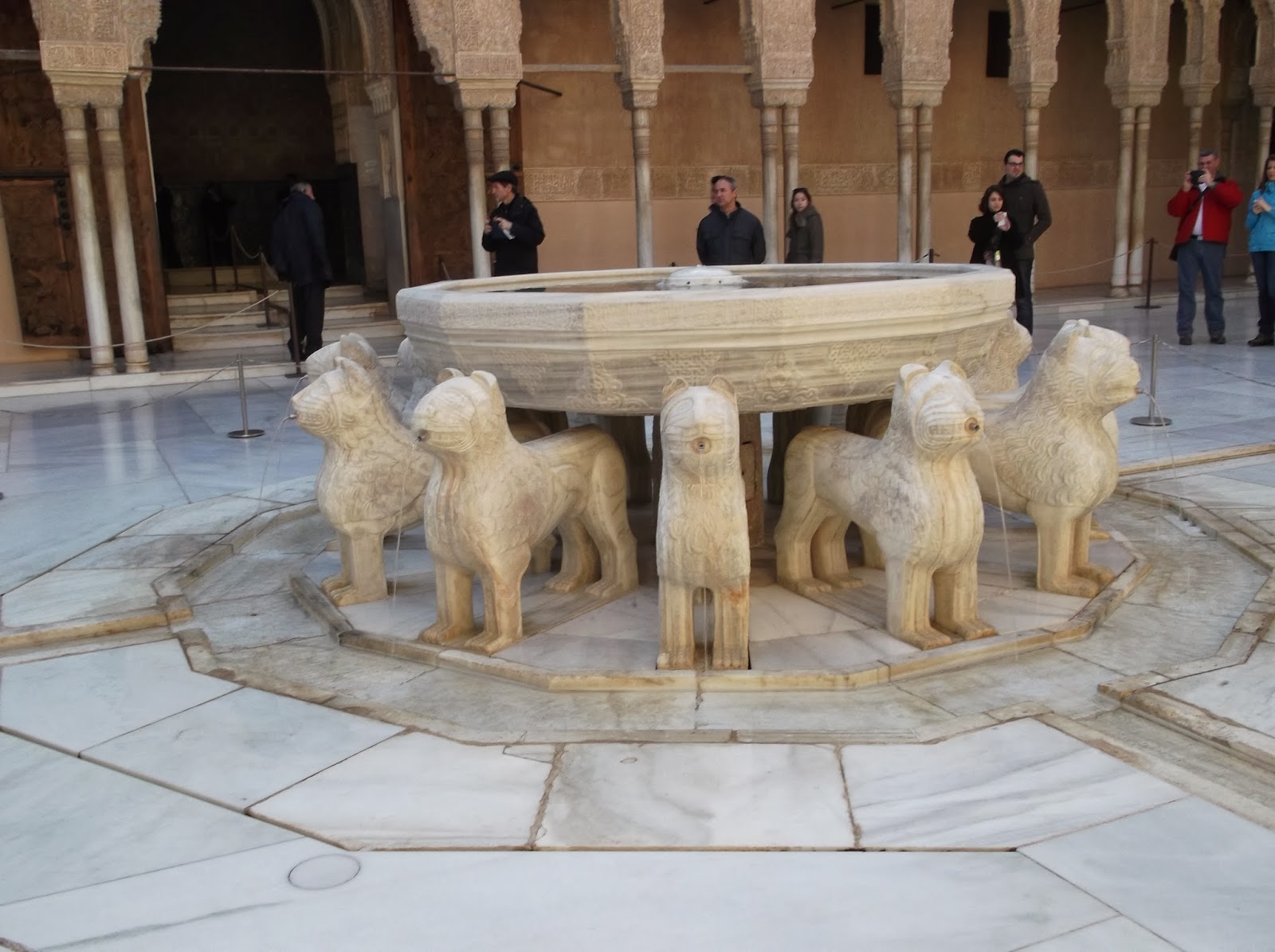
There is always some work being done to maintain this important World Heritage Site and one of the more recent areas to be cleaned is the Patio de los Leones (lions).  Not that lions were ever kept there.  It is named for the 12 marble lions that support the fountain in the centre.  The patio was built by Muhammad V and is lined with arcades and 124 marble columns.  Pretty impressive.

For me some other highlights were:

Sala de los Reyes:  A 14th century banqueting hall with a painted ceiling - on leather.

Salon de los Embajadores:  Another 14th century room.  The ceiling represents the seven heavens of the Muslin Cosmos.
The ceiling of the Salon de los Abencerrajes

Salon de los Abencerrajes, a family that rivalled Boabdil.  According to legend he had them massacred while they were at a banquet in this room.  It is said that the pattern of the stalactite ceiling was inspired by Pythagoras' theorem. I’ll take their word for it!


The Generalife is where the most famous picture is to be found - the narrow pool with fountains arching over it and a palace in the background.  Officially known as the Patio de la Acequia, it is an oriental garden and the palace is the Sala Regia.
From the terrace on one side are fantastic views across gardens towards the Alhambra.


The most 'romantic' garden is the Patio de los Cipreses, otherwise known as the Patio de la Sultana.  It is reputed to have been the secret meeting place of Zoraya (wife of Sultan Abu 1 Hasan) and her lover, the chief of the Albencerrajes.

Think Alhambra and tourists and you know it is going to be overcrowded.  If you want to see it not crowded (as I did) then I'd recommend visiting Granada in early December.  Also, of course, it isn't hot.  At the height of the summer season the heat can be unbearable.  It may not have been hot when I was there, but the sun shone!

Incidentally, did you know that the American writer Washington Irving once stayed at The Alhambra?


Saturday, 28 December 2013

Single Room Supplements


During a recent holiday where I met several other single people the subject of single room supplements came up for discussion.  When doesn't it when holidaying singles get together?  It is a decades old gripe.
In Europe where hotels have single rooms (at least half the size of a double), no bath and invariably no balcony and in the most undesirable locations it is difficult to understand why we should pay more than a couple.  These small rooms are usually 'space fillers' in the building and often found near the lifts, over the kitchen, over the dustbin area (in some countries the dustbins are emptied at night!) or over the staff entrance (some starting work at 5.00 a.m. and now the area where the staff go for a smoke).
Many years ago when I was working in tourism I dealt with hotel/tour operator contracts and discovered that the hotelier charges the tour operator half the cost of a double room for these singles.  So why the single room supplement?  We are told because they are at a premium.
FREE CHILD PLACES.  How many times do you see that in holiday brochures?  Who pays for the 'free' child's flight?  No prizes from where the tour operators get that money.
NO SINGLE ROOM SUPPLEMENT.  True - but look at the dates.  Out of season for the weeks that are difficult to sell.  Think about people who cannot take their holidays then, such as teachers.
Another catch with this phrase is that the single room supplement is included in the price.  These days some tour operators issue special Singles brochures.  Check the prices with the regular brochure and often the Singles price is higher than the normal price.
WE DON'T CHARGE SINGLE ROOM SUPPLEMENTS.  Probably means that everybody is being over-charged!
My advice?  When the hotel isn't full speak nicely with Reception and ask for a double room instead of the closet sized space.  Make sure you have your receipt showing that you've paid the single room supplement.  The majority of hotels are sympathetic and will give you a decent sized room.
AMERCAN  PLAN ROOMS.  These are hotels that don't have single rooms but charge for the room rather than per person.  You can see where the single room supplement comes in can't you?  But why, when you're one person, using one bed and one set of towels and one person's supply of water should you pay for a room that can take two or more people?   
As a single have you ever taken a cruise?  Yup, almost twice the price.  Why?  A single person only eats one person's food (and on a cruise that has to be a BIG saving). 

Sunday, 1 December 2013

Bellver Castle, Palma, Mallorca


Whether you are sailing into Palma or strolling along the promenade called Paseo Maritimo, two buildings dominate the view.  The Cathedral and Bellver Castle, which face each other across the Inner Harbour.

The circular castle with its prominent Keep stands proudly above the City, surrounded by Bellver Woods.  Like all good castles, it is on a hill so, unless you have strong legs and can climb the hill, to reach it you need either a car, a taxi or the hop-on-hop-off tour bus.

Built in the 14th c. by King James II of Mallorca Bellver is one of the most original buildings in the island's history.  It is made of sandstone and is circular with a central courtyard surrounded by 21 arches.  The floor above has 42 arches.  The four large towers face the points of the compass with the Keep (facing north) which is set off to one side.  Several Spanish monarchs have stayed at the castle, including Queen Isabella II, Alfonso XII and Alfonso XIII.  King Juan Carlos and Queen Sofia have also visited it.

During the 18th and 19th centuries the castle was a prison and, during the Spanish Civil War more than 800 republicans (supporters of the lawfully elected democratic government) were imprisoned here.  Now it houses museums including the Palma History Museum and the Despuig Collection of Classical Sculptures.

On the ground floor is the history museum and a Projection Room which is used for education purposes.  The upper story has the Chapel, the oratory of which is dedicated to St. Mark.  The presbytery floor has the original tiles in a green geometric design.

The next room is dedicated to the Spanish Justice Minister, Gaspar Melchor de Jovellanos who was imprisoned at the castle during the reign of Carlos IV (early 19th c).   This is the room that Jovellanos occupied as testified by a memorial tablet and bust.  In the Royal Chamber there are two paintings, one of Jaime I and the other of Jaime III, as well as a throne.

In the late 18th and early 19th centuries Cardinal Antoni Despuig y Dameto collection Roman sculptures and tablets.  One of the rooms on this upper floor contains them and they are gorgeous. 

The last room was the kitchen which originally had a fireplace in the centre - space that is now covered with a model of the castle and park.

I suspect that many people visit Bellver Castle for one reason only - to see the views from the 'Upper terrace' and the Keep.  As the Keep has a narrow spiral staircase of 118 steps I didn't go up but I did stroll around the terrace to admire the views.  Apart from the City itself, the hill town of Genova can be seen to the north while to the west the view is towards Cala Mayor and St. Augustin.

Amazingly, despite having once lived in Mallorca, I had never before had the opportunity to visit this fascinating castle. 


Friday, 15 November 2013

Tobogganing in Madeira


As a child I never tried sliding down the stairs on a tray but I would imagine the sensation was similar to sitting in a laundry basket charging down a hill. Actually it was a wickerwork toboggan in Madeira.  Exhilarating and just a little nerve racking.  Especially when coming to a bend, when the two "guides" manoeuvred the toboggan so that we were at an angle as we cornered. Or when we were approaching a crossroad and wondering if we would stop. We did. We were then pulled across the flat section and set off again down the last hill. I wouldn't have missed the mile long experience for anything.

Everywhere on the island there are hills so the residents don't need gyms to keep fit.  They are all natural mountaineers as their houses seem to be either on top or halfway down the hills with vast flights of steps needed to reach them. 

The scenery is spectacular and the scents that surround you are fantastic.  As you drive through forests of eucalyptus trees you can feel your sinuses clearing.  And everywhere there seem to be flowers such as hibiscus from palest pink through to flame, the elegant cream trumpets of the datura, and agapanthus. A bus journey from just outside Funchal into the city reveals riots of purple and crimson bougainvillea, a plethora of pyrostegia (a climber with a mass of clear orange blooms popularly known as Golden Shower), stately strelitza, red plastic looking anthuriums and, wherever they can get a foothold, nasturtiums. These riot everywhere, including tumbling down the walls of the gorges.
 
Colourful orchid
Wickerwork is a big industry on the island. Like the exquisite embroidery, it was introduced in the early 19th century. The willows were imported from Portugal and can be seen in the east of the island and, like the embroidery and knitting, it is a cottage industry.  Wherever you go in Madeira you will see examples of the canework, be it hotel furniture, baskets in the market - or the toboggans.
 Having mentioned the hills I'm sure you don't need reminding to take comfortable walking shoes.  Also wise to wear them in Funchal and some towns and villages where there are cobblestones. Not the greatest things for walking on.

Bus services are plentiful and all start in Funchal. No matter where you want to go: the Botanical Gardens, Blandys Gardens, Camara do Lobos - the small fishing village much painted by Sir Winston Churchill, anywhere around Funchal or up into the hills to Monte to take a toboggan ride.
Red Hot Pokers

Wednesday, 16 October 2013

Ybor City in Tampa, Florida


Ybor City with its cosmopolitan shops and restaurants is a fascinating corner of Tampa.  It is named after its founder, Vicente Martinez Ybor.  In the 19th century there were revolutionary movements in Cuba because people wanted independence from Spain.  Some moved to the USA, including cigar makers who moved to Key West or to New York.  Ybor and a couple of others moved to Tampa in 1885. 

Ybor adopted the English Victorian mill owners’ idea of building homes for his workers.  In 9th Avenue, just a short walk from the Ybor City Museum, are three of these wooden casitas, which are about a hundred years old.  They sit demurely in a row with steps up to the verandas - you can imagine people sitting there in the evening chatting to passing friends.


There are windows either side of the door which leads straight into the living room.  This is complete with furniture of the time, including some Cuban pieces.  Don’t be surprised to see a stove, it can get quite cold in Florida in the winter.  In one corner, to the left of the front door is a love-seat.  This is where the daughter of the house could sit with her boyfriend – in full view of the rest of the family.  If there was more than one daughter I expect they had to take it in turns!

Behind the living room is the main bedroom - the bed having a mosquito net.  Then there is the nursery with some wooden, hand-made toys.  At the back of the house is the kitchen, complete with a dining area in the corner.  I’ll bet it was hot in there when the lady of the house was cooking.

Ybor City grew quickly with the arrival of more Spaniards, Cubans and Afro-Cubans. Italians came from Sicily to work in the cigar factories, Germans built box factories and became the designers of the cigar labels and boxes.  Other Italians arrived, some of whom grew vegetables, had dairies or opened the grocery stores.  There were also Jews from Romania, who were bankers or shopkeepers.

And there was no racial strife.  They all mixed well together and had their own clubs which provided a full social life and, for a small sum, they also provided medical care for their members. 


The Ybor City Museum, where you can learn all about Ybor’s development, is in the 1923 Ferlita Bakery building. To visit La Casita, you have to go there to get your ticket and meet your guide.